
How to introduce AI safely in your organization
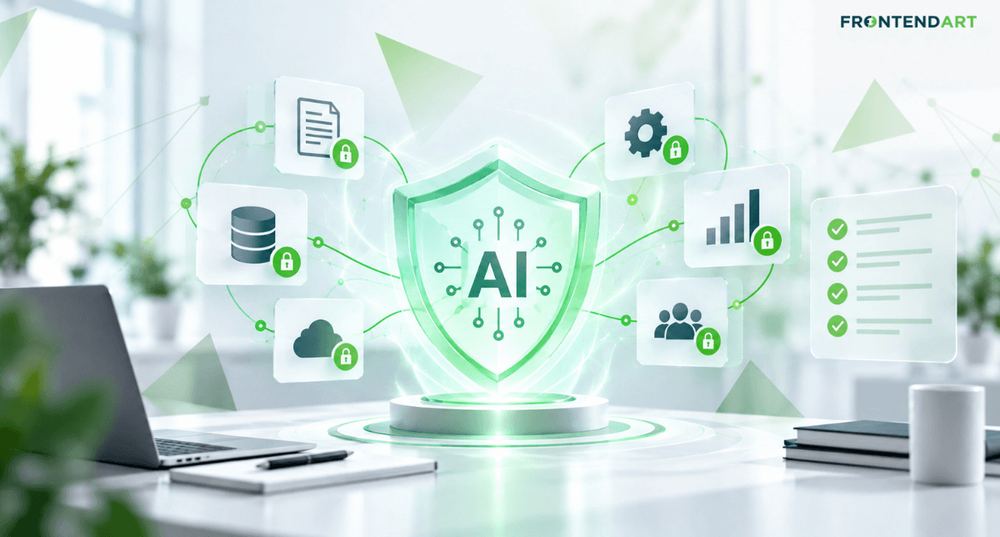
AI can improve efficiency and decision-making, but introducing it into business operations also creates new risks around data access, reliability, and system permissions. A secure enterprise AI solution should be designed around clearly defined business tasks, controlled data sources, appropriate access rights, and human oversight. When these safeguards are built in from the start, AI can become a trusted and traceable part of everyday operations rather than an isolated experimental tool.
AI is becoming embedded in almost every area of our lives. It speeds up work, takes over repetitive tasks, and helps people make better-informed decisions. At the same time, it introduces new security risks, not because AI is inherently dangerous, but because it changes the way data is accessed, processed, and used. The question is therefore no longer whether companies should adopt AI, but how they can integrate it into their operations securely and effectively.
The simplest solution is not always the safest
A general-purpose, off-the-shelf chatbot does not understand a company’s internal processes, roles, or policies. As a result, users often have to provide the necessary context themselves by copying information into the system. This can easily lead to confidential business data being entered into a service whose data handling practices are not fully governed by the organization.
Another concern is the reliability of AI-generated answers. Generative models can produce information that sounds convincing but is inaccurate. Without access to verified enterprise data sources, source references, and appropriate human oversight, it can be difficult to determine whether an answer is actually based on an internal policy or whether it was generated by the model itself.
Prompt injection introduces another potential risk. A user, or even a document being processed by the system, may contain instructions designed to divert the AI from its intended task. With enterprise AI agent-based solutions, it is particularly important to ensure that the AI is not granted more permissions than necessary. A poorly restricted system may not only provide an incorrect answer but could also carry out unintended actions.
Secure enterprise AI starts with real business processes
Instead of giving a general-purpose AI tool broad access to the organization, companies should first define exactly which business task they want AI to support. Searching internal documents, processing quotations, supporting customer service, and performing actions in an ERP system all require different approaches.
The key advantage of custom AI enterprise processes is that the technology can be adapted to the way the company already operates. Organizations can define which data sources the AI may use, which systems it can connect to, and which information or actions individual users are authorized to access. A properly designed enterprise solution can also keep sensitive company files within a controlled environment rather than exposing them to services where their use is governed outside the organization’s own policies.
Responses can be grounded in internal documents and databases, actions can be logged, and human approval can be required before critical steps are executed.
Control should be built in from the design stage
A secure AI implementation therefore does not begin with choosing a model. The first step is to map the task itself, the data involved, the required access rights, and the potential consequences of errors. The system should then be tested in a limited pilot, not only under normal conditions but also with incorrect, ambiguous, or deliberately manipulated inputs.
This is where custom software development can provide a significant advantage. Instead of introducing AI as a separate, general-purpose tool, it can be built directly into the company’s existing systems and adapted to its specific processes.
This makes it possible to define exactly which data the AI may use, which tasks it may perform, which business applications it may interact with, and where human approval is required. Its capabilities are therefore designed around the actual tasks that support day-to-day operations rather than around a generic set of AI features. The result is a solution tailored to the organization both technically and operationally.
Enterprise AI becomes controllable when it fits the company’s processes, has access only to the data and functions it genuinely needs, and operates in a way that can be monitored and traced. It should also be clearly defined where the AI is allowed to act autonomously and where human oversight is required. With these safeguards in place, AI can move beyond being an isolated experimental tool and become a securely integrated part of business operations.
- AI-supported custom software development
- QA management